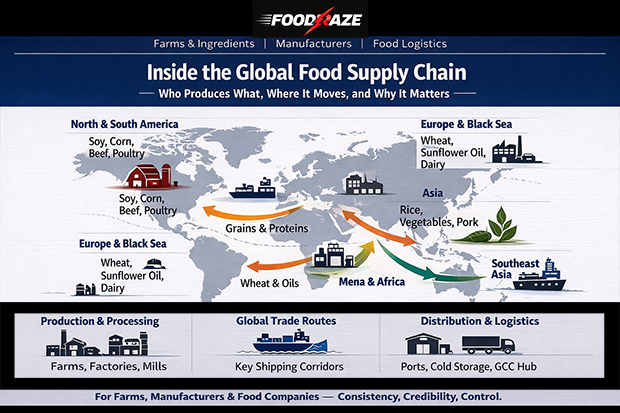
FOODRAZE is built to spotlight the business of food—from farms and factories to manufacturers, distributors, and global buyers. Understanding how food is produced and distributed worldwide is essential for anyone operating in today’s competitive food ecosystem.
Global production: the world’s food engines
Global food production is highly concentrated, shaped by climate, infrastructure, and scale.
- North & South America form the backbone of global bulk agriculture. The United States, Brazil, and Argentina dominate soybeans, corn, wheat, beef, and poultry, supplying both human consumption and animal feed markets worldwide. These regions are export-driven and deeply integrated into global trade.
- Europe & the Black Sea region (Ukraine, Russia, Romania) play a strategic role in wheat, barley, sunflower oil, and dairy. Their output feeds the Middle East, Africa, and parts of Asia, making this corridor critical for food security.
- Asia is both a producer and the world’s largest consumer. China leads in vegetables, pork, aquaculture, and grains, while India is central to rice, dairy, spices, and pulses. Much of Asia’s production serves domestic demand, but surplus commodities drive global trade.
- Southeast Asia dominates palm oil, tropical fruits, seafood, and rice, with Indonesia, Malaysia, Thailand, and Vietnam acting as global suppliers.
- Africa is emerging rapidly, with strong growth in grains, horticulture, cocoa, coffee, and livestock, increasingly attracting investment in processing and export infrastructure.
- Middle East & GCC countries focus less on primary farming and more on food manufacturing, re-export, processing, and logistics, positioning the region as a global food trade and distribution hub.
From farm to factory to market
Food distribution follows a structured chain:
- Primary production (farms, fisheries, plantations)
- Processing & manufacturing (mills, slaughterhouses, food factories, ingredient producers)
- Distribution & logistics (ports, cold storage, wholesalers, free zones)
- Retail, horeca, and foodservice
For manufacturers and suppliers, processing hubs—not farms—are increasingly the center of value creation. Ingredients are sourced globally, processed regionally, and distributed to multiple markets.
Key distribution corridors
The global food system depends on a few major trade routes:
- Americas → Europe, MENA, Asia (grains, proteins)
- Black Sea → MENA, Africa (wheat, oils)
- Southeast Asia → Global (palm oil, seafood)
- Europe → GCC & Africa (processed foods, dairy)
Efficiency, cold-chain reliability, and regulatory compliance define success along these routes.
What’s shaping the future of food trade
For FOODRAZE’s audience—farms, manufacturers, processors, and food companies—three forces matter most:
- Supply chain resilience: diversification of sourcing and regional manufacturing
- Clean-label and functional foods: demand for simpler ingredients and transparency
- Technology-led distribution: data-driven forecasting, traceability, and waste reduction
The global food system is no longer just about volume. It’s about consistency, credibility, and control. Producers who understand where they sit in this chain—and how to position themselves within it—are the ones shaping the future of food.